
Digital Life 4
Course start: 9. oktober 2023
Digital Life 4
Univ.-Prof. Dr. Fares Kayali
This course is part of a MOOC series: Digital life – how digitization is transforming our everyday lives
This course is part of a MOOC series: AI MOOCs
Scientific classification:
Course start: 9. oktober 2023
Digital Life 4
Univ.-Prof. Dr. Fares Kayali
This course is part of a MOOC series: Digital life – how digitization is transforming our everyday lives
This course is part of a MOOC series: AI MOOCs
-
Scope: 5 units
-
Effort: 4 hours/unit
-
Course start: 9. oktober 2023
-
Course end: -
-
Current status: Ongoing course
-
Current participants: 1750
-
Licence: CC BY-SA 4.0
-
Available languages:
Trailer
Course details
Course content
We are all part of an increasingly connected world – a world full of digital opportunities and challenges. The digital transformation is massively reshaping our everyday lives – yet who takes responsibility for the decisions that precede these changes? How much accountability lies with each of us? What is the role of institutions, business and politics? The MOOC “Digitales Leben 4” (“Digital Life 4”) deals with responsibility and accountability in the context of digitality in a total of 20 learning videos. In 5 course units, 8 lecturers discuss the complex field of personal autonomy and governance from technical, social, pedagogical and humanities perspectives to help you broaden your knowledge.
The topics of the 5 course units are:
- Digital equal opportunities and gender inequalities
- Digital care technologies and their design challenges
- Information quality, media literacy and requirements for political education
- Open data and open science as a response to big data and AI
- Digital humanities: New directions in the study of history
“Digitales Leben 4”, “Digitales Leben 3”, “Digitales Leben 2” and “Digitales Leben 1” form a MOOC series on various relevant aspects of the digital revolution and the related transformation processes. The numbers are not meant to indicate an order – as a learner, you can work on any of the “Digitales Leben” MOOCs first. We hope to continue this series in the future!
Learning goals
After completing this MOOC, you will be familiar with key terms in connection with the digital transformation, the application of technologies, responsibility and accountability. You will develop your own points of view based on the speakers’ selected key points. The lectures will enable you to assess the risks and potentials of digital transformation processes, take a constructive and critical stance on digital change, and see yourself as an active part of the digital revolution.
Prerequisites
We welcome participants’ initiative as well as their independent and interest-driven acquisition of knowledge. The course language is German. English language skills are required for some of the written sources (though reading them is optional). The videos in course units 3 and 6 are in English but have German subtitles and transcripts.
Course schedule
The MOOC consists of an introduction, and 5 course units comprising 4 learning videos each. Once you are actively enrolled in the MOOC, all units are available to you and you can work through them in any order you choose. Additional information and interactive elements such as reflection questions and prompts accompany the videos. To develop your own positions, we encourage you to use the forum – we will guide you with discussion prompts for each of the course units. For self-assessment (and for the iMooX certificate), there is a quiz with five questions per unit.
Titles and lecturers of each course unit
- Introduction: overview and explanations (Unit 1)
Univ.-Prof. Dr. Fares Kayali - Digital responsibility and equal opportunities (Unit 2)
Dr. Beate Winkler, Univ.-Prof. Dr. Sabine T. Köszegi, Mag. Doris Schmidauer - Aging, care, and technology (Unit 3)
Univ.-Prof. Geraldine Fitzpatrick, PhD - Information quality: digital responsibility & political education (Unit 4)
Univ.-Prof. Dr. Dirk Lange, Johanna Taufner, MA MSc - Trust and accountability in the time of big data (Unit 5)
Mag. Dr. Katja Mayer - Digital humanities and scholarly accountability (Unit 6)
Univ.-Prof. Dr. Tara L. Andrews
Certificate
Upon course completion, an automated certificate of participation will be provided, stating your username, the course name, the course duration and the amount of work involved. We would like to point out that this certificate will simply confirm that you have correctly answered at least 75 % of the self-assessment questions.
Licence
This work by Cem-Cihan Aslan, Fares Kayali, Vera Schwarz and Matthias Steinböck is licenced under CC BY-SA 4.0.
Additional information
Kursübersicht
- Lektion 1: Einführung
- Einführung Digitales Leben 4
- Spielerisches Element: „Significant Terms“
- Digitales Leben 4 Begriffspuzzle
- Lektion 2: Digitale Chancengerechtigkeit und Verantwortung
- Positive Zukunftsbilder von Digitalität
- Digitale Benachteiligung und Geschlechtersegregation
- Initiative Digitalisierung Chancengerecht
- Digitale Chancengerechtigkeit und Verantwortung – aber wie?
- Lektion 3: Alter(n) und Care im Digitalen Wandel
- Die Herausforderung der Verbreitung von Technologien
- Die Bedeutung unserer Sicht auf das Altern
- Technologien zur Unterstützung der Pflege zu Hause
- Unterstützung des Pflegealltags
- Lektion 4: Informationsqualität: Digitale Verantwortung & Politische Bildung
- Fake News, Informationsqualität und gesellschaftspolitische Herausforderungen
- Fake News: von Diskriminierung bis Indoktrination
- Manipulationsstrategien und Medienkompetenz
- Digitale Bürger:innenschaft und Digitale Verantwortung
- Lektion 5: Vertrauen und Verantwortung in Zeiten von Big Data
- Begriffsbestimmungen
- Datenreisen
- Die Infrastrukturen der Künstlichen Intelligenz
- Open Data und Open Science
Copyright
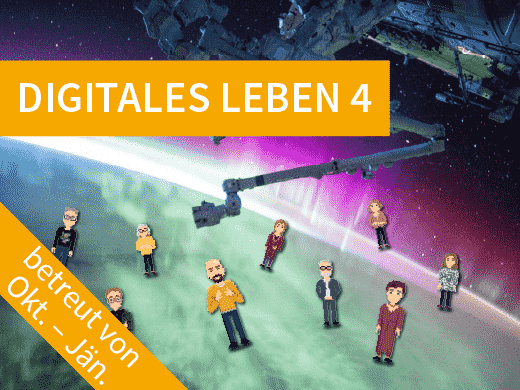
The course image of the MOOC “Digital Life 4” was created by the CTL University of Vienna and is licensed under CC BY-SA 4.0 (https://creativecommons.org/licenses/by-sa/4.0/legalcode).
Background image: Original title: Space Station. Description: Photo of the ISS robotic arm with the Earth in the background. Author: unknown. License: CC0 1.0 (https://creativecommons.org/publicdomain/zero/1.0/legalcode). Origin: https://pxhere.com/de/photo/1059420. Changes: cropped, added text element and avatar graphics.
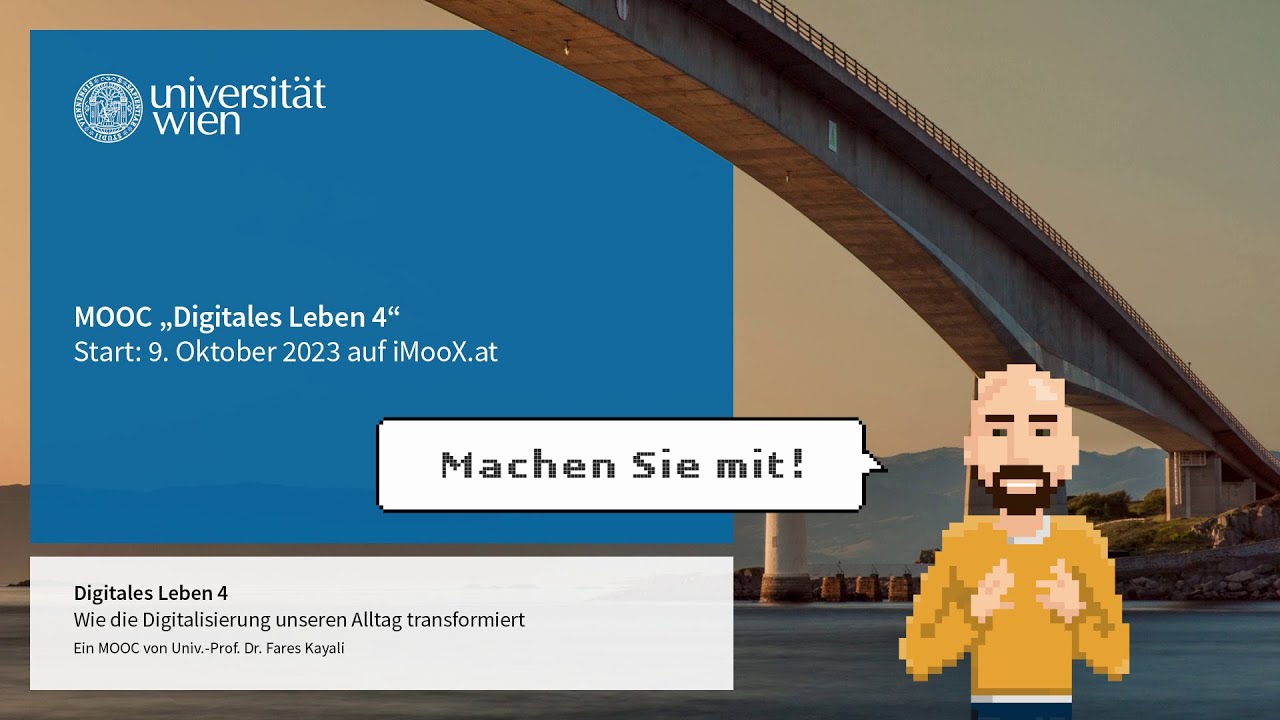
The trailer of the MOOC “Digital Life 4” was created by the CTL University of Vienna and is licensed under CC BY-SA 4.0 (https://creativecommons.org/licenses/by-sa/4.0/legalcode).
Note: The references must be retained if the licensed material is reproduced and/or distributed in whole or in part, or if modified material is created, reproduced and/or distributed.
Course instructor

Univ.-Prof. Dr. Fares Kayali
Prof. Kayali has many years of experience in the interdisciplinary field of computer science, society, and didactics. Among other things, his Digital Education and Learning Group at the Centre for Teacher Education, University of Vienna, runs the Computational Empowerment Lab. His research interests include user-centered design, critical aspects of the digital transformation, and digital as well as serious games. The MOOC series “Digitales Leben” (“Digital Life”) is part of his lecture “Digitale Transformationen” at the University of Vienna.
Lecturers: Univ.-Prof. Dr. Tara L. Andrews Digital Humanities University of Vienna, Univ.-Prof. Dr. Geraldine Fitzpatrick, PhD Human-Computer Interaction Group TU Wien, Univ.-Prof. Dr. Sabine T. Köszegi Labor Science and Organization, TU Wien, Initiative Digitalisierung Chancengerecht (Vienna), Univ.-Prof. Dr. Dirk Lange Didactics of Civic and Citizenship Education University of Vienna, Mag. Dr. Katja Mayer Science and Technology Studies University of Vienna, Mag. Doris Schmidauer Business Consulting, Initiative Digitalisierung Chancengerecht (Vienna), Johanna Taufner, MA MSc Didactics of Civic and Citizenship Education University of Vienna, Dr. Beate Winkler Art and Human Rights, Initiative Digitalisierung Chancengerecht (Vienna)
Partners
-
University of Vienna

This is what other participants particularly liked about this course
based on 1 rating of the course- Interesting videos
- Up-to-date content
- Good lecturers
Ready to learn something new?