
Electromagnetic Compatibility for Engineers
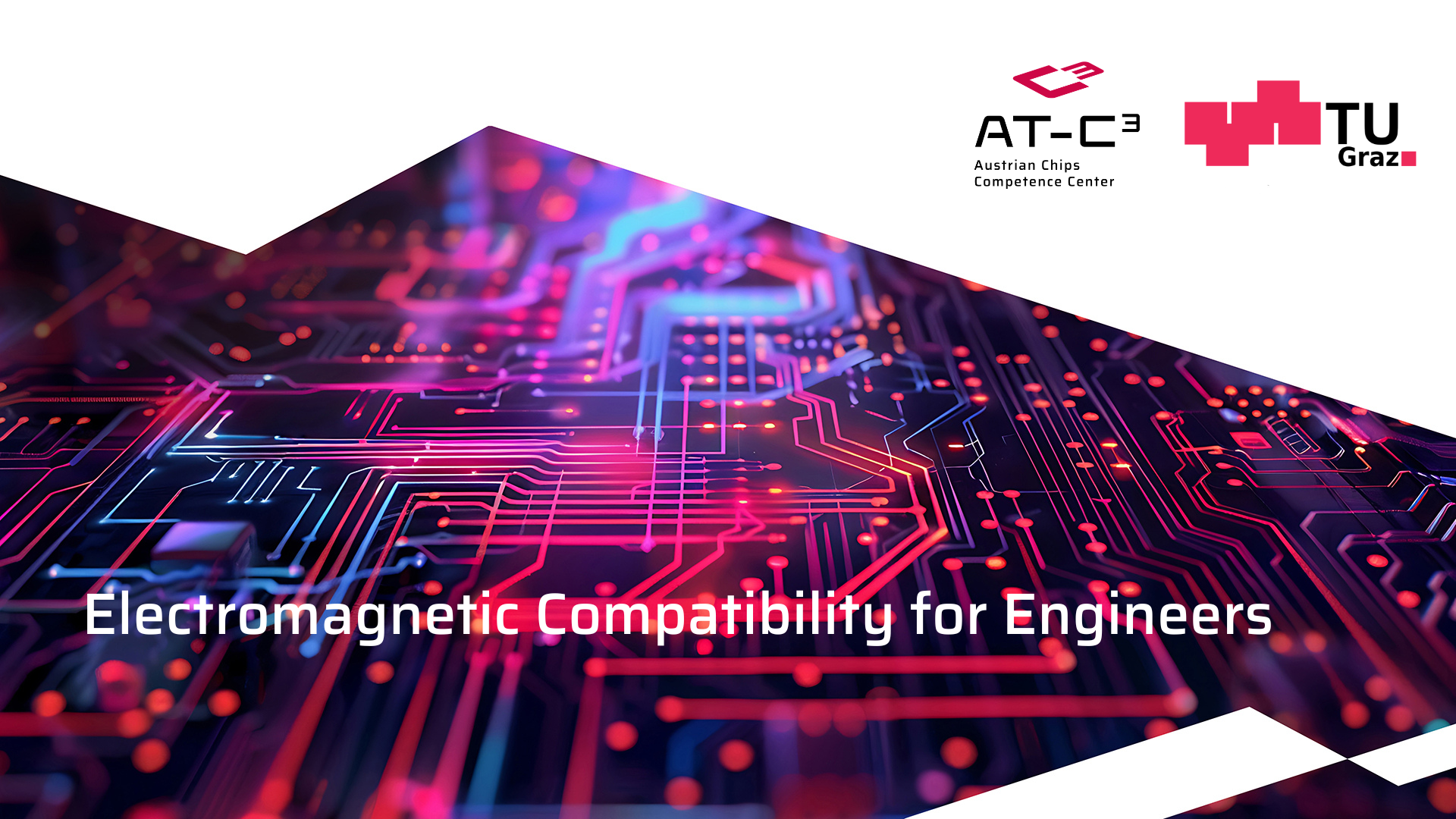
Course start: 1. oktober 2026
Electromagnetic Compatibility for Engineers
Prof. David Pommerenke
Scientific classification:
Course start: 1. oktober 2026
Electromagnetic Compatibility for Engineers
Prof. David Pommerenke
-
Scope: 9 units
-
Effort: 4 hours/unit
-
Course start: 1. oktober 2026
-
Course end: -
-
Current status: Upcoming course
-
Current participants: 75
-
Licence: CC BY 4.0
-
Available languages:
Course details
General
Are you an engineer who wants to work with electromagnetic compatibility, but do you lack the skills? Then this course is for you!
Targeted at working enginners, we have build this course to help you and your company succeed.
Although the target group is working professionals, master and PhD students will benefit as well.
Have fun learning!
This course is developed by the Institute of Electronics at Graz University of Technology along with the Austrian Chips Competence Center.
Course content
In this course, you will gain an overview of electromagnetic compatibility with a special focus on real-world applications. It builds upon our predecessor MOOC Electromagnetic Compatibility Essentials.
Learning goals
Upon completion of the MOOC, learners are able to:
- Classify the types of EMC and the corresponding methods.
- Describe common test methods.
- Solve simple, but illustrative, theoretical exercises.
Prerequisites
Completion of the MOOC Electromagnetic Compatibility Essentials or equivaltent qualifications.
Course schedule
The course consists of ten lessons with an average workload of 4 hours, equivalent to a total of 1.5 ECTS.
Every lesson is immediately available and ends with a self-assessment quiz.
Certificate
For actively participating in the course you will receive an automatic certificate which includes your name, the course name as well as the completed units. We want to point out that this certificate merely confirms that you answered at least 75% of the self-assessment questions correctly.
Licence
This work by Prof. David Pommerenke, Loreta Stojanova, Prof. Jan Hansen, Bibhu Nayak PhD and Henrik Siboni is licenced under CC BY 4.0.
Additional information
We hope you enjoy the course. Feel free to reach out to the Institute of Electronics and the Austrian Chips Competence Center at any time.
Course instructor
Prof. David Pommerenke
David Pommerenke (Fellow, IEEE) received the Diploma and the Ph.D. degree in electrical engineering from Technical University Berlin, Berlin, Germany, in 1990 and 1996, respectively. He was with Hewlett Packard, Houston, TX, USA, for five years. He became a Faculty with the Electromagnetic Compatibility Laboratory, Missouri University of Science and Technology, Rolla, MO, USA. In 2020, he joined the Faculty of the EMC Laboratory, Graz University of Technology, Graz, Austria. His current research interests include system-level ESD, electronics, numerical simulations, EMC, measurement methods, and instrumentation. Dr. Pommerenke is an Associated Editor for the IEEE Transactions on Electromagnetic Compatibility.
Partners
This MOOC is offered by the Institute of Electronics at Graz University of Technology. We are a partner organisation in the Austrian Chips Competence Center.
The project is supported by the Chips JU and its members including top-up funding by the FFG.
Funded by the European Union. Views and opinions expressed are however those of the author(s) only and do not necessarily reflect those of the European Union or the FFG. Neither the European Union nor the granting authority can be held responsible for them.
-

Graz University of Technology
-
Austrian Chips Competence Center (AT-C3)
-

Co-funded by the European Union
-
National funding agency for industrial research and development in Austria (FFG)
-
Chips Joint Undertaking (Chips JU)i
-

National Foundation for Research, Technology and Development
Ready to learn something new?