
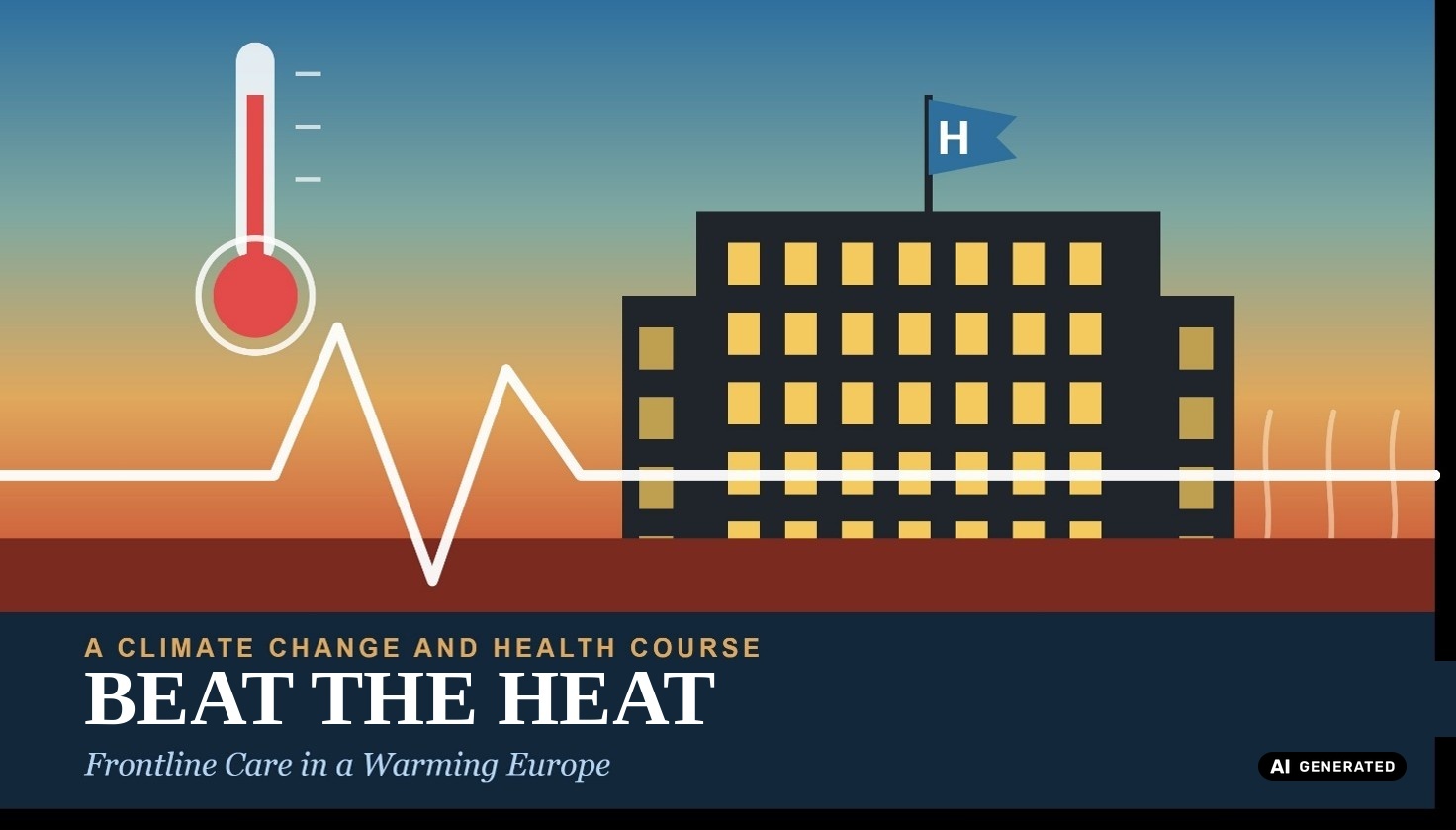
BEAT THE HEAT: Frontline Care in a Warming Europe
Available from: 1 februari 2027
BEAT THE HEAT: Frontline Care in a Warming Europe
- Stephan Böse-O´Reilly
- Professor Cathryn Tonne
Scientific classification:
Available from: 1 februari 2027
BEAT THE HEAT: Frontline Care in a Warming Europe
- Stephan Böse-O´Reilly
- Professor Cathryn Tonne
-
Scope: 7 units
-
Effort: 5 hours/unit
-
Available from : 1 februari 2027
-
Available until: available indefinitely
-
Current status: upcoming course
-
Current participants: 2
-
Licence: CC BY 4.0
-
Available languages:
Course details
General
The MOOC Health in Heat: Frontline Care in a Warming Europe equips health personnel across Europe with the evidence, tools and clinical skills to understand, prevent and respond to the health impacts of climate change. The course moves learners from foundational scientific literacy through to system-level and sector-wide action. The lessons can be completed individually according to participants' areas of interest.
Course content
Following an introductory lesson on the evidence base, six further lessons cover the core climate-health topics relevant to frontline practice. Each lesson combines a short expert lecture, a practitioner interview or podcast, curated evidence and readings, one applied professional case, and a knowledge check.
The lessons cover the following topics:
- Lesson 1: Climate Change & Health in Europe: The Evidence Base Establishing a common foundation in climate-health hazards and vulnerable groups, and how to interpret European evidence using CATALYSE and the Lancet Countdown.
- Lesson 2: Heat Stress and Health — From Evidence to Action Understanding heat-health risk, early warning systems and heat-health action plans, population-level protection measures, and compound hazards such as wildfire smoke.
- Lesson 3: Health Co-benefits of Climate Mitigation How climate mitigation in transport, food, energy and buildings can improve health, and how to use co-benefit arguments in professional advocacy.
- Lesson 4: Occupational Heat Stress and Migrant Workers Assessing heat stress risk in the workplace, the specific vulnerabilities of migrant and seasonal workers, and legal frameworks and protective protocols.
- Lesson 5: Clinical Recognition and Prevention Recognising and managing heat-related illness, chronic disease exacerbation, paediatric and perinatal risk, and patient communication.
- Lesson 6: Health System Adaptation Assessing the climate resilience of health services, cost-effective adaptation measures, and continuity planning during extreme weather events.
- Lesson 7: Decarbonisation of the Health Care Sector Identifying emissions sources in health systems, life-cycle assessment, and established decarbonisation pathways
Learning goals
- describe the principal climate-related health hazards affecting European populations and the groups most at risk
- recognise and manage the clinical spectrum of heat-related and climate-sensitive illness
- interpret current evidence and apply it in professional decision-making
- assess the adaptive capacity and climate resilience of a health service
- describe decarbonisation pathways for the health care sector
- communicate effectively with patients and colleagues on climate-related health risk
Prerequisites
No special prior knowledge is required. The course is designed for four groups of health and public health professionals across Europe:
- Clinicians treating the elderly and chronically ill (GPs, nurses, ER staff, care home professionals) — the key mediators for patients at highest risk of climate-related harm.
- Paediatricians, midwives and gynaecologists — caring for infants, children, pregnant women, and neonates, who face heightened biological vulnerability.
- Occupational Health and Safety professionals — especially relevant to agriculture (including migrant farmworkers), construction, and logistics.
- Public health practitioners and policymakers — at local, regional, and national level, translating evidence into policy.
Course schedule
The course comprises 7 lessons totaling approximately 35 hours of learner effort:
- Climate Change & Health in Europe — the evidence base
- Heat Stress and Health — from evidence to action
- Health Co-benefits of Climate Mitigation
- Occupational Heat Stress and Migrant Workers
- Clinical Recognition and Prevention
- Health System Adaptation
- Decarbonisation of the Health Care Sector
Certificate
For actively participating in the course you will receive an automatic certificate which includes your name, the course name as well as the completed units. We want to point out that this certificate merely confirms that you answered at least 75% of the self-assessment questions correctly.
Licence
This work by UMIT TIROL is licenced under CC BY 4.0.
Course instructor
Stephan Böse-O´Reilly
Professor Cathryn Tonne
Partners
-
UMIT TIROL | The Tyrolean Private University
Ready to learn something new?